
KPJA SUCCESSFULLY CONCLUDES 5-DAY IT & AI TRAINING FOR JUDICIAL OFFICERS (OCTOBER 26 TO 30, 2026)
PESHAWAR: The Khyber Pakhtunkhwa Judicial Academy (KPJA), Peshawar, successfully completed its five-day specialized training program titled "Foundational IT Skills and AI Core Competencies for Judicial Officers" (Batch-II), running from October 26 to 30, 2026. Designed in alignment with the National Guidelines for Use of Artificial Intelligence in Judicial Institutions of Pakistan approved by the National Judicial (Policy Making) Committee (NJPMC), the course equipped judicial officers with practical digital skills, ethical frameworks, and hands-on AI workflows to modernize court administration while strictly maintaining human oversight and judicial independence. A total of 21 judicial officers successfully completed the intensive program and were awarded certificates of completion.
The training formally commenced with a grand inaugural ceremony graced by the Hon’ble Mr. Justice Wiqar Ahmad, Judge, Peshawar High Court, who attended as Chief Guest. In his keynote address, the Chief Guest highlighted the growing importance of digital proficiency and technology adoption in streamlining court management, expediting case disposition, and reducing procedural backlogs. Crucially, Mr. Justice Wiqar Ahmad delineated a fundamental ethical boundary, emphasizing that while artificial intelligence should be fully utilized to facilitate the process and administration of justice, it must never be used in the determination of justice, ensuring that human judgment, transparency, and judicial integrity remain uncompromised.
Earlier, Director General KPJA, Mr. Kalim Arshad Khan, presented the welcome address, reaffirming the Academy’s strategic commitment to building digital competencies across the provincial judiciary. All Senior Directors, faculty members, and senior administrative officers of the Academy were present on the occasion.
Delivered on individual lab workstations using a hands-on, tool-by-tool approach, the course covered five core thematic modules:
- Day 1: AI Foundations & Core MS Word Processing
Following LMS onboarding, Mr. Ahmed Iftikhar, Dean Faculty KPJA, introduced fundamental AI concepts, distinguishing Generative, Agentic, and Predictive AI models from traditional search engines. Mr. Dost Mohammad Khan, Director Instructions KPJA, led basic and advanced Microsoft Word lab sessions focusing on document formatting, headers, sections, automated tables of contents, track changes, and inline comments required for judicial drafting. - Day 2: Gemini Ecosystem, Audio Transcription & AI Agents
Facilitated by Dr. Omer Usman (FAST University, Peshawar), participants explored the Gemini platform, speech-to-text dictation (OpenAI Whisper / Omnilingual ASR), and local offline LLMs (LM Studio / Ollama) to process sensitive material securely. Judicial officers built practical AI agent scenarios including document redaction pipelines, trial record chronology extractors, and case law citation auditors. - Day 3: ChatGPT Ecosystem, Privacy Controls & Source-Grounded Analysis
Led by Dr. Arif Shah (Dean Faculty, CUSIT, Peshawar), sessions focused on fast versus reasoning models, privacy configurations (Temporary Chat, model-improvement controls), structured prompting, and Canvas. Officers performed source-grounded document analysis with exact page citations and converted court spreadsheets into visual data charts. - Day 4: Claude Ecosystem, Multi-File Analysis & Artifact Creation
Conducted by Prof. Dr. Awais Adnan (IM Sciences, Peshawar), judicial officers engaged in multi-file version comparisons, Claude Projects, and Artifact creation—generating, inspecting, and verifying Word and Excel files alongside visual charts. - Day 5: Ethical AI Adoption, Judicial Guidelines & Post-Assessment
Mr. Ahmed Iftikhar, Dean Faculty KPJA, conducted specialized sessions on ethical boundaries, transparency, and data privacy mandated by the National AI Guidelines. Participating officers then undertook a formal Post-Assessment Test on the KPJA Moodle LMS portal. As per KPJA grading policy, performance was evaluated out of 100 marks (70% post-training knowledge and lab skills, and 30% for punctuality, professional conduct, and active lab participation).
The training program culminated in a formal valedictory ceremony chaired by the Hon’ble Mr. Justice Ijaz Anwar, Senior Puisne Judge, Peshawar High Court / Vice Chairman, KPJA, who graced the occasion as Chief Guest. Addressing the gathering, the Chief Guest commended the Academy for conducting a timely, practical course aligned with national judicial policy and reiterated that ethical AI adoption enhances administrative efficiency without replacing judicial wisdom. Director General KPJA, Mr. Kalim Arshad Khan, delivered the concluding remarks, thanking the Chief Guest, faculty, and administrative staff for their dedicated efforts.
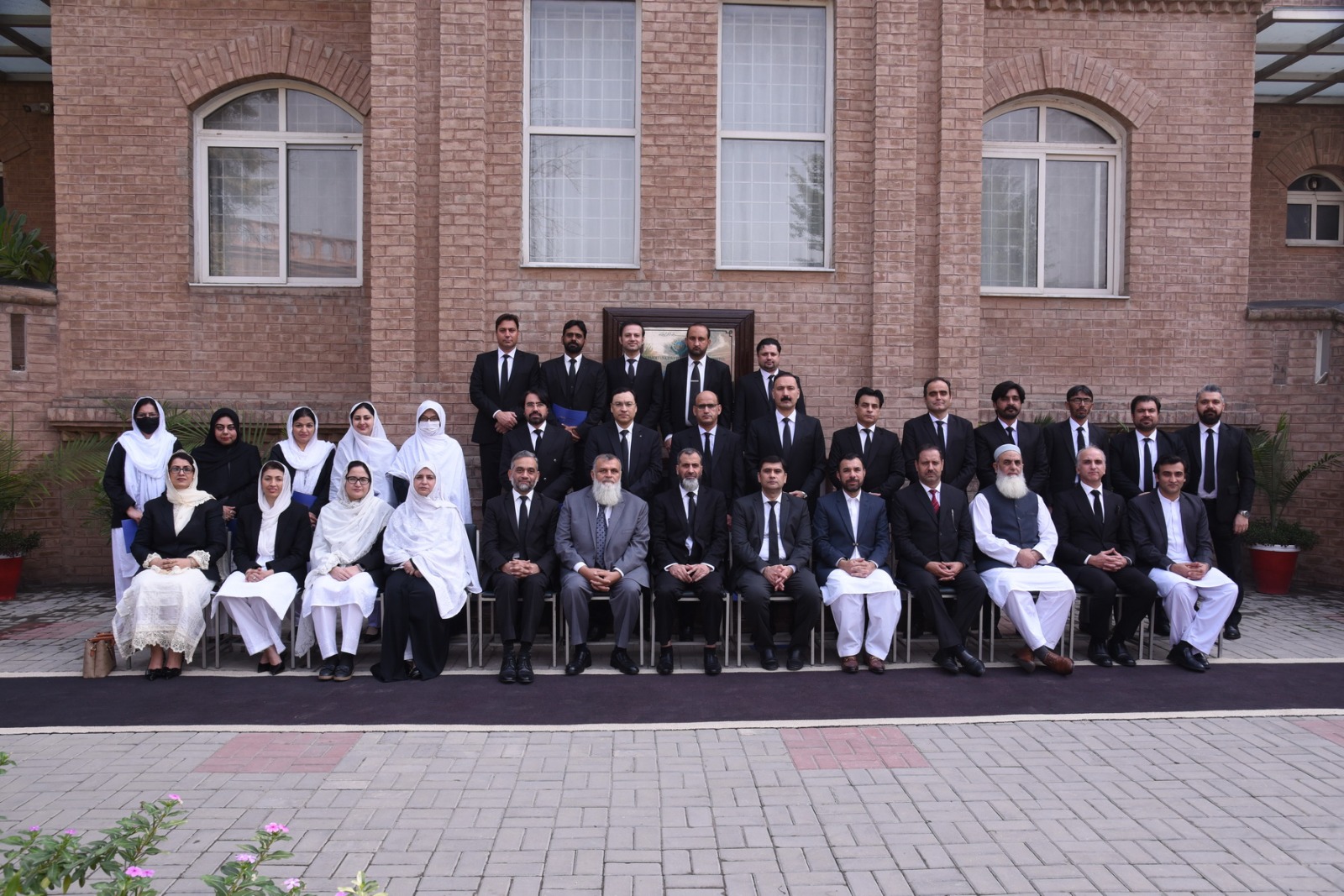
During the ceremony, the Chief Guest and Director General conferred certificates of completion upon the 21 successful judicial officers. Speaking on behalf of the cohort, the Class Representative expressed heartfelt gratitude to the KPJA management, praising the practical hands-on curriculum, seamless Moodle LMS integration, top-tier computer lab facilities, comfortable residential accommodation, and constant support provided by the Academy’s faculty and administrative team throughout the week. The landmark event concluded with an official group photograph.